Posted on 26 May 2015
Featured By South Wales Argus
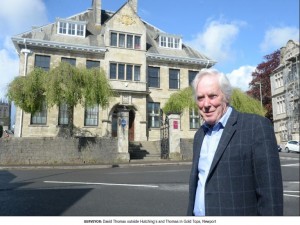
“I WAS born in Swansea in 1945. My father was a solicitor and my mother was a housewife. When I was one, we moved to Surrey where I was brought up. I went to Malvern College and then to College of Estate Management and I qualified in 1965 when I was 20 years old.
“I went to art college briefly before that but my father said I was mucking around and he said to go and do something sensible. I wanted to be a painter; I painted all the time. All my life I have been interested in art and have just loved painting and sculpture. Neither of my parents were into art.
“When I was 23 I was still living in Surrey, but when I got married to Sue we moved to Earls Court in London. I then started working at a firm called Donaldson’s , a very well-known firm. We had three children, a daughter Claire who was born in 1970, Martin in 1972 and Michael in 1978. When we had Claire we decided we didn’t want to bring her up in London so we
moved to Bristol and I worked in Bristol for nine years.
“Then in 1980 I saw an advert for a firm in Newport called Powell, Tuck and Partners and so that year we moved to Monmouth and I became a partner at the firm. We bought an old farmhouse dating from the 1600s, it was derelict and we completely rebuilt it did it up which took 35 years but it is now finished.
“In 1988 we sold the firm to Abbey National and myself and three other partners worked for them in Cardiff for five years. But then two of us, myself and Richard Hutchings, decided we’d start again. Abbey National heard that and asked us to leave. So we left there and set up Hutchings and Thomas in 1993.
We didn’t have any cars, we just had two of their mobile phones and no office. We came across to Newport with not much at all. That morning was daunting; when we left I thought, I have got three children and no job. It didn’t take long though and we got it going.
Fortunately, the landlord at the offices we used to be in with Powell Tuck and Partners at Goldtops from nothing was still there and he said we could come back in here. So we found ourselves back where we had been before. We had to get these cheap old second-hand cars.
“We were based in Newport but were working all over the country. I used to do a lot of work for the biggest Spar retailer in this part of the country, Capper and Co.
We had a turnover approaching £1million. There was a satisfaction of building something up virtually from nothing and in the end we had about 15 people working for us. We started in 1993 and our first employee joined in 1996.
“About five years ago Richard Hutchings, whose son is in Goldie Lookin’ Chain, wanted to retire so he left. Then I became a consultant. Now Robert Carew-Chaston, David Pugsley and Haydn Thomas are carrying on the business and I’m gradually working less and less.
“In the middle of this I was also a magistrate for ten years. I was also a governor at Coleg Gwent and continued to paint. I painted virtually every day, mainly from photos at the kitchen table. I used to watch the TV with one eye and paint with the other. I always used to do oil but now do more watercolours. I paint buildings and landscapes mainly but do people as well, mainly people who interest me like historical characters.
“The Royal Academy of Arts Summer Exhibition is on every year, there’s about 16,000 pictures submitted and they choose about a tenth of that. I thought I’d have a go. You go up there and you can put three paintings in. I managed to get a picture in two years running in 1982 and 1983, but then I got rejected for about five years. They hang your work in the exhibition
for about two to three months and they are all for sale. My father went and he bought my painting for £200.
“One of my paintings was an old palace in France and I did it through the gates with the palace in the background.
“With my other paintings, I don’t usually sell them or give them away because they are my babies. Because I’m only painting in the evenings, they only take me a week. A watercolour is only a couple of hours. I have painted scenes from Spain and France and the States. I take a lot of photos and then bring them home and work on them, although I’m not always satisfied with the end result.
“In 1998, two of my friends – one who I went to playgroup with and had known since aged three, and another I had known since 16 – wanted to do a big drive. The two of them had done quite a few drives, mainly around England, and they decided to do this one to Cape Town from London without going over water at all. I got on board and late in the day thought I might as well raise some money for charity, and in the end I raised about £2,000. We started from Canary Wharf and went through the Channel Tunnel and then we went right through Europe. Places to stay were organised but we did take tents and some people camped, but I’m pleased to say we never unpacked the tent once. From Turkey we went to North Africa, we went down through the whole of Africa. We were going to go through Ethiopia but they started fighting. A lot of the places we went through you wouldn’t be able to go through today. We drove 13,000 miles and we were very fair about sharing the driving – every hour we swapped around. We would stop as well and have a wander. It was absolutely wonderful to get to Cape Town and sit by the sea and have a beer, it was absolutely such a relief. The drive was incredibly stressful. The roads are extremely bad in Romania and in Africa, our tyres kept bursting. Then you have got the locals charging around in big lorries. Some of these countries are completely lawless. We drove as fast as we could the whole way and it took six weeks. Several of the other vehicles didn’t make it at all, some crashed.
“After that I said I would never do it again, but then 10 years later in 2008 I did another one. We drove 7,000 miles from Arizona to Fairbanks in Alaska.
“It was incredibly eventful. We did 500 miles in one car but then it blew up, we walked to a nearby Indian reservation and found a Navaho Indian who had a pick-up truck and he agreed to drive us to Salt Lake City. Me, my friend and this Indian sat in the front of this truck and drove for two days.
“We found a German mechanic who specialised in the engine and left it with him while we took four different cars to do the rest of the journey. That trip was about two-and-a-half weeks and then I definitely said no more for good.
“Now I come in most days to the business and keep painting.
“The company is doing very well, which is always nice.”


